
Choosing a printing service in New York City is not just about finding someone who can produce paper materials. It means selecting a production partner that can consistently deliver high print quality, fast turnaround times, a full range of production capabilities, and reliable service in one of the fastest-moving business environments in the world.
In a market where deadlines are tight and brand perception forms instantly, the right print partner can improve marketing performance, protect brand credibility, and prevent costly reprints. The wrong one can lead to missed campaigns, inconsistent branding, and operational delays that impact business results.
This guide explains exactly how to evaluate a professional printer, what standards to expect, and how to choose a provider that delivers speed, precision, consistency, and dependable production across every job.
What Makes a Professional Printing Service? The Four Standards That Matter
Not all printers are equal. A professional printing service is defined by four measurable capabilities:
- Output quality: the resolution, color accuracy, and finish of the final product
- Turnaround speed: how quickly production can be completed without sacrificing quality
- Production range: whether the printer can handle everything from business cards to large-format signage under one roof
- Operational reliability: consistent results, transparent timelines, and responsive communication
If any one of these is weak, your printed materials become a liability rather than an asset.
Does Print Quality Actually Affect Your Brand?
Yes, and the impact is immediate.
Consider this: a law firm in Midtown Manhattan sends a prospective client a proposal printed on flimsy paper with slightly off-color branding. The content may be excellent, but the physical experience undermines it before a single word is read. Studies in consumer psychology consistently show that tactile quality influences perceived credibility.
Professional print quality is defined by specific technical benchmarks:
| Quality Factor | Professional Standard | What Happens Without It |
| Resolution | 300 DPI or higher | Text appears blurry or pixelated |
| Color system | CMYK calibrated output | Colors shift between screen and print |
| Paper weight | 250–400 GSM for cards | Materials feel cheap and bend easily |
| Trim accuracy | Within ±1 mm | Edges appear uneven or misaligned |
| Ink consistency | Even saturation, no banding | Visible streaks or faded sections appear |
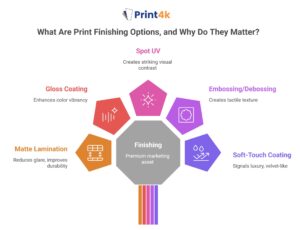
What Are Print Finishing Options, and Why Do They Matter?
Finishing is what separates a printed sheet from a premium marketing asset. It is the difference between a business card someone pockets and one someone throws away.
Common professional finishing options include:
- Matte lamination: reduces glare, improves durability, and gives a sophisticated feel. Ideal for menus, folders, and presentation covers.
- Gloss coating: enhances color vibrancy and creates a polished, high-energy look. Common for flyers, postcards, and retail materials.
- Spot UV: applies a glossy varnish to specific design elements (a logo, a headline) against a matte background. Creates striking visual contrast.
- Embossing or debossing: raises or recesses a design element to create a tactile texture. Frequently used on premium business cards and invitations.
- Soft-touch coating: a velvet-like finish that signals luxury. Used widely in fashion, hospitality, and high-end retail.
A full-service print provider should offer all of these in-house. If a printer outsources finishing, it introduces delays, inconsistencies, and additional cost, all of which you absorb.
How Fast Should a Professional Printer Be? Turnaround Times Explained
In New York City, a 48-hour delay can mean missing a product launch, a conference, or a campaign window. Turnaround time is not a secondary consideration, it is a core service metric.
Standard professional turnaround benchmarks:
| Job Type | Standard Production Time | Rush Available? |
| Business cards | 24–48 hours | Yes, same-day |
| Flyers and brochures | 1–2 business days | Yes |
| Booklets and catalogs | 2–3 business days | Case by case |
| Large format signage | 2–4 business days | Yes, with lead time |
| Labels and packaging | 2–3 business days | Yes |
What does “same-day printing” actually mean? It means your job is produced and available for pickup or delivery within the same business day the order is placed, provided print-ready files are submitted before the cutoff time (typically late morning). Any printer who cannot define this clearly before taking your order is a reliability risk.
Example: Assume a restaurant group in NYC needed updated menus printed after a last-minute pricing change. Their usual online vendor quoted five business days plus shipping. A local print shop completed the job in four hours. The dinner service ran without disruption.
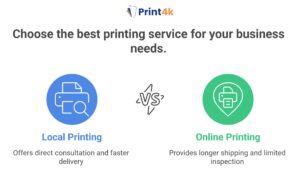
Local Printer vs. Online Printing Service: Which Is the Better Choice?
This is one of the most common decisions businesses face, and the answer depends on your priorities.
Why Local Printers Have the Advantage in NYC
Working with a local provider gives you capabilities that online vendors structurally cannot offer:
- Physical proof review before full production— you can inspect color, paper, and finish before 5,000 units are printed
- Direct consultation with production staff— not a chatbot, not a ticket system, but a technician who understands your files
- Same-day problem resolution— if something is wrong, it can be fixed and reprinted the same day
- No shipping delays— materials are ready for pickup or local delivery, not sitting in a distribution center in another state
- Regional expertise— a printer that regularly handles jobs like custom banner printing for Manhattan events or same-day flyers in the Bronx understands real-world NYC deadlines in a way no out-of-state vendor can
Where Online Printing Falls Short
Online vendors can be cost-effective for non-urgent, high-volume commodity jobs. But they carry real limitations:
- Shipping timelines of 5–10 days are common, with no guarantee on delivery
- File errors are often caught only after production, requiring a full reorder
- Customer support is typically remote and slow to resolve urgent issues
- Rigid production workflows make customization difficult
Bottom line: For time-sensitive campaigns, brand-critical materials, or anything requiring custom finishing, a local printing company in New York is the operationally sound choice.
What Services Should a Full-Service Print Shop Offer?
Fragmenting your print production across multiple vendors is one of the most common and costly mistakes businesses make. It introduces inconsistency, delays, and higher overhead.
A full-service printer should produce all of the following under one roof:
- Business cards
- Flyers and brochures
- Postcards and mailers
- Booklets and catalogs
- Banners and event signage
- Labels and product packaging
- Large-format graphics and displays
- Corporate and Professional document printing
Why does this matter? When your business cards, brochures, and banner all come from the same press, calibrated to the same color profile, your brand looks consistent across every touchpoint. When they come from three different vendors, subtle color shifts and paper variations accumulate into a brand that looks disjointed, even if the individual pieces look fine in isolation.
What Is a Print-Ready File, and Why Does It Matter?
A print-ready file is a digital file specifically formatted for professional production. Submitting files that are not print-ready is the single most common cause of delays, color errors, and reprints.
Print-Ready File Requirements
| Specification | Required Standard | Common Mistake |
| File format | PDF (preferred) | Submitting Word docs or low-res JPEGs |
| Color mode | CMYK | Submitting RGB files (screen-optimized) |
| Resolution | 300 DPI minimum | Using 72 DPI web images |
| Bleed area | 3 mm beyond trim edge | No bleed causes white edges after cutting |
| Crop marks | Included | Missing marks cause misaligned cuts |
| Fonts | Embedded or outlined | Missing fonts cause text substitution |
Real example: Say a startup in Lower Manhattan submitted a pitch deck for booklet printing with fonts not embedded. The printer’s system substituted a default font, changing the entire typographic character of the document. A pre-press file review, standard at professional print shops, would have flagged this before production.
If your printer does not offer a file review step, ask for one. If they cannot provide it, consider that a warning sign.
What Are the Most Common Mistakes Businesses Make When Choosing a Printing Service?
Choosing Based Only on Price
The lowest quote rarely produces the lowest total cost. When color errors, reprints, and missed deadlines are factored in, a cheaper printer often ends up costing more. Evaluate value, quality, speed, and reliability, not just the line-item price.
Submitting Files Without Checking Specifications
Every professional print job requires CMYK files at 300 DPI with bleed. Submitting files that do not meet these specifications halts production and forces a resubmission, sometimes days later.
Ignoring Reputation and Reviews
A printer’s portfolio and verified client reviews are the most reliable indicators of consistent performance. Ask to see samples. Look for reviews that mention specific job types similar to yours.
Waiting Until the Last Minute for Complex Jobs
Rush production is possible for straightforward jobs. For booklets, custom finishing, or large-format campaigns, compressed timelines increase the risk of errors. Build in adequate lead time whenever the job complexity warrants it.
Working with Multiple Vendors for One Campaign
Using different printers for your business cards, brochures, and signage introduces color variation and brand inconsistency. Consolidating with one full-service provider eliminates this risk.
How to Evaluate Any Printing Service: Expert Checklist
Before placing an order with any printer, confirm the following:
- Sample quality matches your expectations for paper, color, and finish
- Turnaround times are clearly documented and committed to in writing
- Finishing options (lamination, coating, UV, embossing) are available in-house
- A pre-press file review is offered before production begins
- Production capacity can handle your job size and complexity
- Delivery logistics are reliable and local
- Customer support is accessible by phone or in person, not just email tickets
If any of these are unclear before you place an order, request clarification. A professional print provider will answer every one of these questions without hesitation.
When Is Same-Day Printing Not Recommended?
Same-day production is well-suited to straightforward jobs: standard business cards, single-sided flyers, basic signage. It is not always the right choice for:
- Jobs requiring complex finishing (embossing, spot UV, soft-touch lamination)
- Large-quantity orders where precision consistency is critical
- Projects requiring exact Pantone color matching
- Materials that require multiple proof revisions before approval
For high-precision or high-stakes projects, scheduled production, with a proof review stage, ensures the best possible outcome.
Why Businesses Across NYC Trust Print 4K
Print 4K is built around the operational realities of high-demand metropolitan businesses. The production infrastructure, turnaround capabilities, and service range are structured to meet the specific needs of companies operating in one of the world’s most competitive markets.
Same-Day and Rush Production
Urgent materials, event signage, campaign flyers, corporate presentations, can be produced and ready for pickup or delivery within the same business day. This includes same day booklet printing in Elmont for businesses throughout Long Island and the surrounding metro area.
Professional Document Printing
High-resolution production for legal briefs, financial reports, corporate presentations, and training manuals. Every page is produced with the precision and durability that professional documents require.
Large Format and Custom Signage
Event graphics, storefront displays, trade show backdrops, and promotional banners, produced on durable materials engineered for urban environments and extended use.
Complete Production Under One Roof
All major print products are produced within a single integrated workflow, ensuring color consistency, brand alignment, and streamlined ordering across campaigns.
Regional Coverage Across the Metro Area
Service extends across Manhattan, Brooklyn, Queens, the Bronx, and Staten Island, with extended support across New Jersey and the broader metro region.
Frequently Asked Questions About Choosing a Printing Service in NYC
1. How do I know if a printing service is professional?
Answer– Look for four things: documented turnaround times, in-house finishing options, a pre-press file review process, and a verifiable portfolio of completed work. If any of these are absent, ask why before placing an order.
2. What is the difference between CMYK and RGB printing?
Answer– RGB is the color system used by screens. CMYK is the color system used by professional printing presses. Submitting RGB files to a CMYK press causes color shifts, reds can print as orange, blues as purple. Always submit files in CMYK for print production.
3. What does 300 DPI mean, and why does it matter?
Answer– DPI stands for dots per inch, it measures the resolution of your image or file. At 300 DPI, print output is sharp and detailed. Below 150 DPI, text and images appear blurry or pixelated. Web images are typically 72 DPI and must be replaced with high-resolution versions before submitting for print.
4. How far in advance should I order printed materials?
Answer– For standard jobs (business cards, flyers), 2–3 business days is sufficient. For booklets, custom finishing, or large-format signage, allow 5–7 business days to ensure accuracy and quality. Same-day options are available for urgent, straightforward jobs.
5. Is it better to use a local NYC printer or an online service?
Answer– For brand-critical materials, time-sensitive deadlines, or anything requiring custom finishing, a local NYC printer is the better operational choice. Online services are better suited to non-urgent, high-volume commodity jobs where you can afford 5–10 days of shipping time and have no need for physical proof review.
6. What should I bring when visiting a print shop in person?
Answer– Bring your files on a USB drive or be prepared to share them via a file transfer link. Confirm your color mode (CMYK), resolution (300 DPI minimum), and whether your file includes bleed. Knowing your quantity, paper preference, and desired finish before you arrive will significantly speed up the consultation.
Choosing the Right Printing Service: The Decision That Protects Your Brand
Every physical touchpoint your business creates, a business card, a brochure, a banner at an event, is a direct reflection of your standards. The materials you put into the world either reinforce your credibility or quietly undermine it.
Choosing a printing service is not a commodity decision. It is a brand decision. The right partner delivers speed, precision, consistency, and reliability in a market where all four are non-negotiable.
If your business requires fast turnaround, professional-grade output, comprehensive service under one roof, and a production partner that understands the pace of New York City, Print 4K is equipped to meet those demands.
From product launches to corporate communications to everyday marketing, the right printing partner ensures every piece you produce reflects your business at its best.