

Choosing the right business card paper stock comes down to three core factors: the weight of the card, the finish you select, and how well both reflect your brand identity. A 16pt card with a soft-touch matte finish signals luxury and restraint, while a glossy 14pt card feels energetic and bold. Get this decision right, and your card does real work long after the handshake.
In this blog, you will find a complete breakdown of paper stock weights, finish options, key decision factors, and practical advice to help you choose the right combination for your brand before you place a single print order.
What Is Business Card Paper Stock?
Paper stock refers to the physical material your business card is printed on. It determines how the card feels in someone’s hand, how well it holds ink and color, and how durable it remains over time. Stock is measured in points (pt), where higher numbers mean thicker cards. The most common weights used in professional printing range from 14pt to 32pt, with 16pt being the industry standard for most businesses.
Beyond weight, the finish applied to the stock dramatically changes its look and perceived value. Finishes include matte, gloss, soft-touch, spot UV, and silk laminate, each serving a different aesthetic and functional purpose.
Understanding both dimensions, weight and finish, gives you full control over the impression your card leaves behind.
How Does Business Card Paper Stock Affect Your Brand Perception?
This is the question most business owners skip, and it is also the most important one to answer before you place a print order.
Paper stock communicates before your contact information even registers. Research from print industry analysts shows that tactile quality influences perceived brand credibility. In one study by Ipsos, 72% of people said the quality of a business card reflects the quality of the company behind it. That is not a small number when you consider how often cards change hands at networking events, trade shows, and client meetings. (source)
A flimsy card printed on thin stock can undercut even the most polished logo and color scheme. On the other hand, a thick, well-finished card adds physical weight to your brand’s authority.
Here is a practical breakdown of the most common stock and finish combinations:
| Stock Weight | Finish | Best For |
| 14pt | Gloss | Budget-friendly, high-volume distribution |
| 16pt | Matte or Gloss | Standard professional use across industries |
| 18pt | Soft-touch or Silk | Creative professionals, consultants, premium brands |
| 32pt | Uncoated or Spot UV | Luxury brands, executives, high-impression networking |
The table above is not exhaustive, but it gives you a reliable starting framework to match stock to professional context.
Key Factors to Consider When Choosing Your Paper Stock
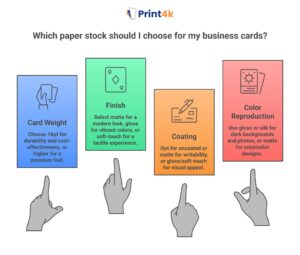
Card Weight and Rigidity
Weight affects durability and first impression simultaneously. A 16pt card is firm enough to resist bending in a wallet but light enough to keep printing costs reasonable at scale. If your brand positioning leans toward premium, moving up to 18pt or 32pt is worth the added cost per unit.
Wondering what that actually costs? See real pricing breakdowns in our guide: How Much Does Business Card Printing Cost in New York?
Finish and Tactile Experience
Matte finishes absorb light and feel smooth without shine. They work particularly well for brands that want a clean, modern, or understated look. Gloss finishes reflect light and make colors appear more vibrant, which suits brands with bold color palettes or photographic elements.
Soft-touch laminate is becoming increasingly popular among creative agencies and consultants because it has a velvety texture that is almost impossible to put down once you pick it up. That physical engagement is worth something.
Spot UV is a coating applied selectively to specific areas of the card, such as a logo or a name, creating a raised, shiny contrast against a matte background. This technique is especially effective for making the company logo printing services central to the design, drawing the eye directly to your brand mark.
Coating and Writability
If your role requires writing appointments or notes on business cards, uncoated or matte stock is your best option. Gloss and soft-touch laminate surfaces resist pen ink and can smear. This is a practical consideration that often gets overlooked until after the cards are printed.
Color Reproduction
Dark, rich backgrounds and photographic images render best on gloss or silk finishes. Matte stock can slightly mute color intensity, which is a desirable trait for minimalist designs but a limitation for color-heavy ones. Always request a printed proof before committing to a full print run.
Comparing Digital and Offset Printing for Paper Stock
The printing method you choose also interacts with your stock selection. Digital printing solutions offer fast turnaround, lower minimum quantities, and strong color consistency across short runs. This makes digital ideal for startups, freelancers, and businesses that update their information frequently.
Offset printing, by contrast, delivers superior color accuracy and is cost-effective at higher volumes, typically above 500 units. It also handles specialty inks, such as Pantone colors, better than digital equipment.
For most small to mid-sized businesses ordering under 500 cards, digital printing on a 16pt stock will deliver excellent results without the setup costs associated with offset.
Want a deeper comparison before deciding? Read our full guide on Offset vs Digital Printing for Business Cards
Challenges to Watch Out For
Overcomplicating the Finish
More is not always better. Stacking multiple specialty finishes on a single card, for example, soft-touch laminate combined with foil stamping and spot UV, can produce a cluttered tactile experience and drive up costs significantly. Pick one premium element and let it lead.
Ignoring Environmental Considerations
Recycled and FSC-certified paper stocks are increasingly available through most print providers. If sustainability aligns with your brand values, this is worth communicating on the card itself, either through a small printed note or via your brand messaging.
Not Ordering a Sample Pack
Most professional print providers offer sample packs that let you feel different stock weights and finishes before committing. This step eliminates guesswork entirely. If you are working with online business card printing services, look specifically for providers that ship physical sample kits, not just digital previews.
Not sure what to look for in a printer? Our guide to choosing a printing service in New York City
Practical Advice for Getting Your Order Right
Start by defining one word that should describe how your card feels. Confident. Refined. Creative. Approachable. That single word will guide your stock and finish selection more reliably than any chart.
Once you have your direction, request a printed proof in the exact stock and finish you intend to order. Review it in natural light, not just under fluorescent office lighting, since finishes behave differently depending on environment.
If your business serves a specific local market, factor in regional context. For example, businesses offering business card printing services in Elmont can often source faster turnarounds through local or regional print shops that stock popular weights and finishes without extended shipping delays. Local print shops also allow you to handle samples in person, which removes all ambiguity from the decision.
Finally, order slightly above your anticipated need. Reprinting small batches is disproportionately expensive compared to ordering a modest surplus upfront.
If you’re based in the New York area, our complete guide to business card printing in New York, it covers local options, what to expect on turnaround times, and how to get your order right the first time.
FAQ: Business Card Paper Stock
What is the best paper stock weight for business cards?
For most professionals, 16pt is the ideal starting point. It is thick enough to feel substantial without being unnecessarily heavy, and it is compatible with the widest range of finishes. If your brand positioning is premium or luxury, consider 18pt or 32pt for a noticeably more impressive physical presence.
What is the difference between matte and gloss finish on business cards?
Matte finish absorbs light and produces a smooth, non-reflective surface that feels refined and modern. Gloss finish reflects light and intensifies color vibrancy, making it better suited to designs with rich colors or photographic imagery. Neither is universally superior; the right choice depends on your design and brand tone.
Can I write on a business card with a gloss finish?
Writing on gloss-coated stock is difficult because the surface resists most pen inks and is prone to smearing. If you need to write on your cards, choose uncoated stock or a matte finish, both of which accept ballpoint and felt-tip pens reliably.
How does paper stock affect printing costs?
Heavier stock and specialty finishes increase per-unit costs, but the difference is often smaller than expected when ordering in reasonable quantities. Moving from 14pt gloss to 16pt soft-touch matte typically adds a modest premium per card. The investment usually pays off in perceived quality and brand recall.
Is recycled paper stock a good option for business cards?
Yes, and the quality has improved significantly in recent years. Recycled stocks are available in a range of weights and can be paired with most standard finishes. They are a credible choice for brands where sustainability is a genuine value, not just a trend to follow.
Conclusion
Your business card is a physical expression of your brand. The stock and finish you choose shape the first tactile impression you make, and that impression carries weight, sometimes literally. By matching card weight to your brand positioning, selecting a finish that complements your design, and understanding how printing method and stock interact, you make a decision that works in your favor every time a card changes hands.
Take the time to request samples, define your brand feel in clear terms, and treat the paper as seriously as you treat the design printed on it. The difference between a forgettable card and one that gets kept comes down to exactly these details.